
Littekencreme met SPF
What does an SPF factor indicate? And which factor is best for sensitive or damaged skin?

SPF 30, SPF 50, SPF 50+… sunscreen comes in all shapes and sizes. But what does an SPF actually mean? And which factor is best for damaged or sensitive skin?
The meaning of SPF
“SPF” is short for “Sun Protection Factor”, i.e. the degree to which a product protects your skin from the sun. Strictly speaking, however, this term isn’t quite accurate.
That’s because sunlight consists of different types of UV rays, including UVA rays and UVB rays. Read more about this in our blog ‘A beautiful summer’.
SPF only tells you something about the level of protection against UVB rays and nothing about protection against UVA rays.
SPF only tells you something about protection against UVB rays
UVB rays
UVB rays cause sunburn. You can remember this with a simple mnemonic: the “B” stands for “Burning” (or “Browning”).
If your skin would normally burn after 10 minutes, then SPF 10 means you would be protected against UVB rays for 10 × 10 minutes.
Some days your skin burns faster than others. If you’re in the Netherlands and want to know how strong the sun is that day, you can check the KNMI website. How strong the sun is depends on many factors, including the season, where you are (in the mountains the radiation is much stronger) and the time of day.
UVA rays
SPF says nothing about protection against UVA rays. Yet protection against UVA rays is at least as important.
UVA rays penetrate deep into the skin and cause damage that can lead to skin ageing, such as wrinkles and pigmentation, and even skin cancer. Here too there’s a mnemonic: the “A” of “Aging”.
And even on a cloudy day, UVA rays are present. UVA rays penetrate through clouds. They also penetrate through glass and clothing.
Which SPF for damaged or sensitive skin?
If you have damaged skin, it’s wise to choose a high SPF. But—just as important—choose a sun protection product that also protects against UVA rays, because these penetrate deep into damaged skin.
UV radiation and scars
You should always protect your skin well against UVA and UVB rays. But this is especially important if your skin is damaged or if you have a scar.
Skin that has only just closed after a wound or surgery is very vulnerable. Too much sunlight can cause permanent discolouration in that damaged skin. And if the damaged skin burns, there’s a risk of lasting pigmentation changes.
So try to keep damaged skin out of the sun as much as possible. This isn’t always possible, especially now that you know UVA rays can even pass through clothing. In that case, choose a scar cream that (also) protects against UVA and UVB rays.
How can you tell whether a sunscreen also protects against UVA rays?
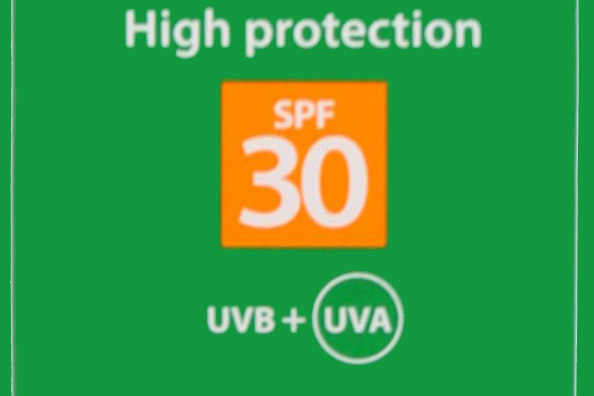
If a sunscreen also protects against UVA rays, this will be stated separately on the packaging. How it’s stated varies by brand. Often you’ll see a small circle around the letters UVA.
Protection against UVA rays
If a sunscreen provides protection against UVA rays, this will be stated separately on the packaging. You will often see the letters UVA with a small circle around them.
Alhydran with SPF 30
Alhydran with SPF is not only a scar cream, but also a sunscreen. In fact, it’s a product you should ideally always have with you. The base of Alhydran is 40% Aloe Vera, which is processed fresh. This scar cream also contains vitamin E and vitamin C.
Alhydran with SPF protects against both UVA and UVB rays. If your skin is damaged or if you have scars, it’s extra important to protect your skin well against both types of UV rays.
By using Alhydran you can help prevent scarring, and you can fade existing scars or even make them disappear. The cream contains skin-friendly ingredients. If you have dry, sensitive skin, or if you suffer from eczema, you can use this scar cream.
You can also use Alhydran with SPF 30 as a replacement for sunscreen. Alhydran protects against both UVA and UVB rays, so you have less to worry about there.
Apply Alhydran with SPF 30 to damaged skin or a scar under (light) clothing, and also on cloudy days. Also try to stay out of the sun as much as possible—especially during the hottest part of the day, when UV radiation is strongest.
SPF 30 or 50?
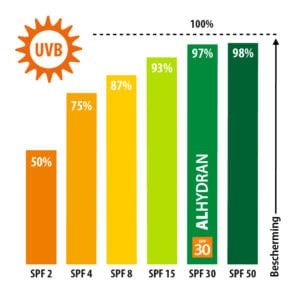
Of course you want to protect your skin as well as possible. But a sunscreen never provides 100% protection. Whether you choose SPF 30 or 50 makes only a small difference. This image shows the relationship between SPF and the level of protection your skin has against UVB rays.
Alhydran with SPF 30 provides 97% protection
Unfortunately, you can never protect your skin 100% against harmful UV rays. So try to stay out of the sun as much as possible if your skin is damaged. But if you have to be in the sun, Alhydran with SPF provides over 97% protection.
Bapscarcare Silicone Gel with SPF 25
The scar cream from Bapscarcare is a silicone gel with scientifically proven effectiveness. Because you can never completely keep damaged skin out of the sun (for example on the face and hands), it’s important to protect it against harmful UV rays. Bapscarcare silicone gel with SPF protects against both UVA and UVB rays.
This silicone gel is fragrance-free and dries quickly. Once applied to damaged skin or a scar, the skin feels silky soft. The gel helps make scars flatter, softer and smoother. Complaints such as redness, itching and irritation will also decrease.
Apply Bapscarcare silicone gel with SPF to your scar even on cloudy days and under (light) clothing.
You cannot use this silicone gel with SPF as a replacement for sunscreen on your face, the way you can with Alhydran. The silicone gel is intended for the treatment of scars.